
What Is Zinc Borate and Why Ultrafine Particle Size Matters
Zinc borate is an inorganic compound widely used as a halogen-free flame retardant and smoke suppressant in various industries. Its chemical formula typically ranges from 2ZnO·3B₂O₃·3.5H₂O (ZB-2335)—the most common hydrated form—to anhydrous grades depending on the application requirements. Variants like the 3.5H₂O type retain crystal water, crucial for maintaining flame-retardant characteristics.
Main Grades of Zinc Borate
- ZB-2335 (2ZnO·3B₂O₃·3.5H₂O): Hydrated form, widely used for flame retardancy.
- Anhydrous zinc borate: Water-free, ideal for heat-sensitive processes.
- Other custom grades designed for specific polymer systems or thermal profiles.
Key Applications
Zinc borate’s value lies in its ability to function as a halogen-free flame retardant and smoke suppressant, especially in:
- Polyolefin compounds like polyethylene and polypropylene for wire & cable insulation (LSZH).
- Engineering plastics including PA66, PBT, and PET.
- Intumescent coatings and rubber products.
- PVC conveyor belts and other polymer blends where smoke suppression and fire resistance are mandatory.
Why Ultrafine Particle Size (D97 < 5 μm) Matters
Grinding zinc borate to an ultrafine size—where 97% of particles are below 5 microns (D97 < 5 μm)—brings significant advantages:
- Improved dispersion: Smaller particles mix more uniformly in polymer matrices, enhancing additive performance.
- Synergy with other flame retardants: Ultrafine zinc borate works better with Alumina Trihydrate (ATH) and Magnesium Hydroxide (MDH), improving overall flame-retardant efficiency.
- Enhanced mechanical properties: Fine particles reduce surface defects and promote consistent material strength.
- Higher flame-retardant efficiency: Increased surface area boosts chemical activity, reducing the amount of additive needed.
Overall, ultrafine zinc borate powder optimizes flame retardancy and smoke suppression with minimal impact on polymer processing and final product quality. This makes precise particle size reduction essential for meeting demanding industrial standards.
Traditional Grinding Methods vs Air Jet Milling for Zinc Borate
Traditional grinding methods like ball mills, Raymond mills, and mechanical impact mills often fall short when it comes to producing ultrafine zinc borate powder. These methods generate excessive heat during grinding, which risks dehydrating zinc borate and damaging its flame-retardant properties. They also tend to produce a broad particle size distribution (PSD), leading to inconsistent quality and poor dispersion in end-use applications. Moreover, contamination from metal parts is a common problem, reducing the overall purity of the product.
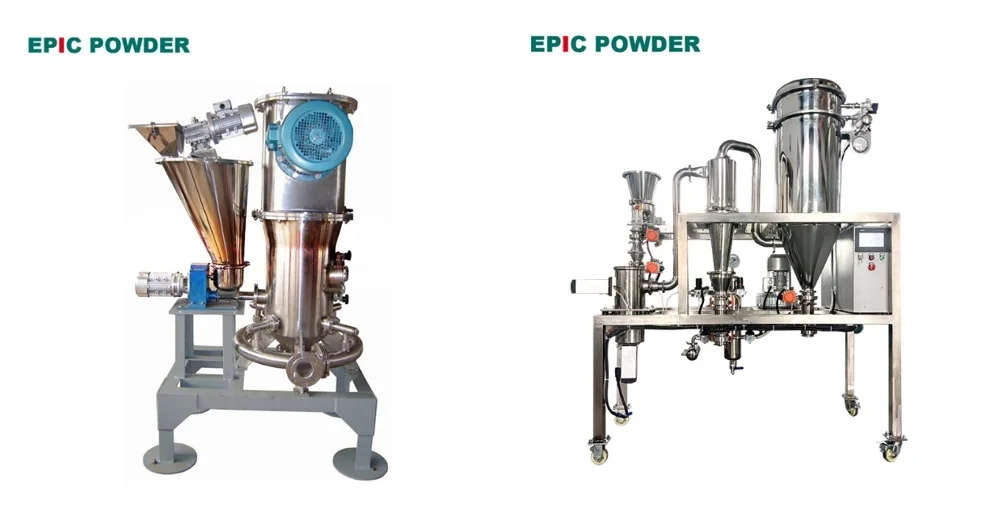
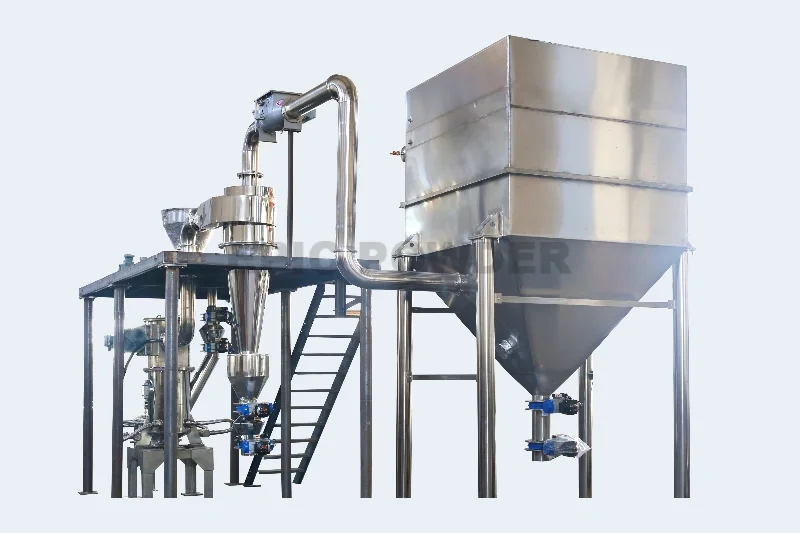
On the other hand, fluidized-bed air jet mills offer clear advantages for zinc borate micronization. Operating at low temperatures, air jet milling preserves the crystal water content critical for flame retardancy. The design features no moving mechanical parts in the grinding zone, virtually eliminating contamination risks. This method yields a narrow PSD with D97 values well below 5 μm, ensuring excellent dispersion and performance. High purity and reproducibility make fluidized-bed jet mills the preferred choice for producing ultrafine zinc borate powder, especially in halogen-free flame retardant applications.
For more on advanced mineral powder processing, check out our insights on polypropylene modified mineral powders.
Real Industrial Case: Zinc Borate Ultrafine Pulverization Project
In a recent industrial project, 400 mesh zinc borate was ultrafinely pulverized to achieve a target particle size of D97 ≤ 5 μm. Using the EPIC Powder Machinery Fluidized-Bed Jet Mill, we successfully reached a product particle size of D97 = 4.80 μm, confirmed by Malvern Mastersizer analysis.
Key production details include:
- Production capacity: 126 kg/h
- Air consumption: 10 m³/min
- Classifier speed and grinding pressure: Optimized for narrow PSD and high throughput
This project highlights how precise control of equipment parameters can deliver consistent ultrafine zinc borate powder ideal for high-performance flame retardant and smoke suppressant applications.
For more insights on dry grinding techniques and equipment settings, you can explore our detailed guide on dry grinding.
Key Process Parameters That Affect Final Particle Size
Controlling particle size during ultrafine pulverization of zinc borate in an air jet mill depends on several key factors. Optimizing these ensures consistent D97 < 5 μm with minimal quality issues.
| Parameter | Impact on Particle Size | Notes |
|---|---|---|
| Feeding rate | Too fast → larger particles, uneven grinding | Keep steady for uniform size reduction |
| Grinding pressure | Higher pressure → finer particles | Needs balance to avoid excessive energy use |
| Classifier wheel speed | Faster speed → finer product, narrow PSD | Precise adjustment critical for D97 target |
| Temperature control | Over 290 °C causes zinc borate dehydration | Maintain below 280 °C to preserve crystal water content |
| Moisture content | High moisture → clogging, poorer milling efficiency | Pre-dry feed material for stable operation |
Monitoring and adjusting these parameters helps maintain ultrafine zinc borate powder quality and improves overall milling efficiency. For example, a steady feed rate combined with optimal classifier speed can deliver very narrow particle size distribution (PSD), crucial for flame retardant performance.
For insights on classifier technology contributing to particle size control, see our detailed guide on air classifier systems.
Performance Advantages of Air Jet Milling for Zinc Borate
Air jet milling offers clear benefits when it comes to producing ultrafine zinc borate powder. One of the biggest advantages is the ultra-narrow particle size distribution (PSD), which means the product has very consistent particles and almost no oversize fractions—particles above 10 μm are nearly nonexistent. This uniformity is crucial for ensuring excellent dispersion and performance in flame retardant and smoke suppressant applications.
Another key benefit is the preservation of the crystal water content within zinc borate. Unlike high-temperature grinding methods, the gentle low-temperature process of air jet milling avoids dehydration, maintaining the chemical structure and effectiveness of the borate. Plus, this method eliminates iron contamination because there are no abrasive moving parts in contact with the material.
From an operational standpoint, air jet milling consumes less energy per ton to achieve submicron particle sizes compared to traditional mills, making it more cost-effective for high-quality zinc borate micronization. These combined advantages make fluidized bed jet mills the preferred choice for producing ultrafine zinc borate powders tailored for demanding industrial uses.
For more insights on powder modification techniques, you might find the article on the key roles of the seven powders in rubber modification helpful.
Applications of Ultrafine Zinc Borate Powder (D97 < 5 μm)
Ultrafine zinc borate powder with a D97 below 5 μm is ideal for a wide range of demanding applications where flame retardancy and smoke suppression are crucial.
- Polyolefin wire & cable compounds (LSZH): Improves fire safety by enhancing flame retardant properties without adding halogens, meeting low-smoke zero-halogen standards.
- Engineering plastics (PA66, PBT, PET): Ensures better dispersion and mechanical strength while boosting flame resistance in nylon and polyester-based materials.
- PVC conveyor belts & cables: Offers excellent smoke suppression and flame retardancy, extending product life and safety in industrial environments.
- Intumescent coatings: Enhances thermal insulation and fire protection by promoting expanded char formation.
- Rubber tracks and seals: Provides durable, halogen-free flame-retardant performance critical for automotive and industrial rubber parts.
The ultrafine particle size also significantly improves the synergy of zinc borate with other key flame retardants like ammonium polyphosphate (APP), magnesium hydroxide (MH), and aluminum hydroxide (MDH), delivering enhanced overall fire safety and performance.
For more details on similar mineral processing and particle size control, you can check out our article on the four major deep processing technologies of kaolin purification, which shares overlapping insights relevant to high-purity ultrafine powders.
How EPIC Powder Machinery Solves Common Ultrafine Grinding Challenges of Zinc Borate
Grinding ultrafine zinc borate comes with specific hurdles like material sticking, overheating, and moisture loss—issues EPIC Powder Machinery handles with precision. Here’s how we tackle these challenges:
- Customized lining materials inside the jet mill prevent zinc borate powder from sticking to equipment surfaces, ensuring smooth operation and minimal downtime.
- A precise temperature monitoring system keeps the grinding environment under control, avoiding zinc borate dehydration which can occur above 290 °C.
- For sensitive anhydrous grades, our closed-loop nitrogen system option protects the crystal water content by preventing oxidation and moisture exposure.
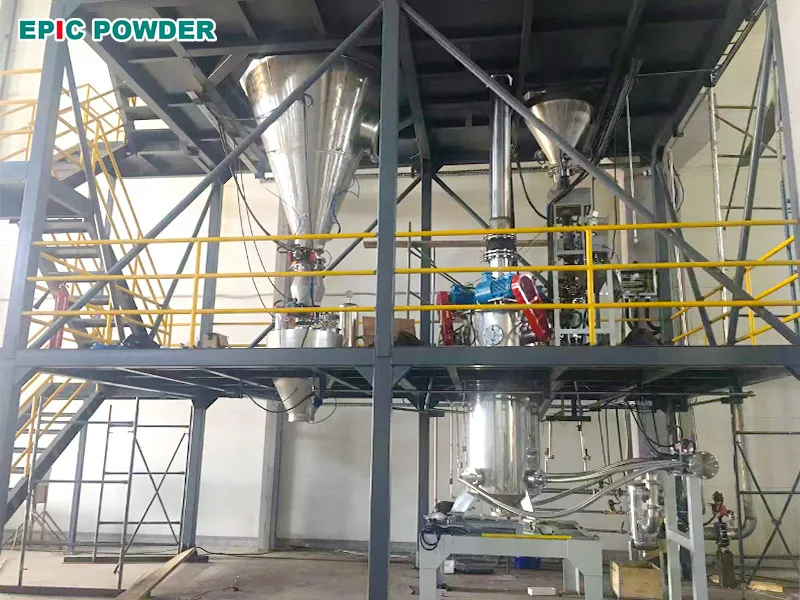
- EPIC provides a complete turnkey solution covering the entire process: from feeding the raw material → jet milling → classification and separation → collection → to packaging. This seamless integration guarantees consistent ultrafine particle size and high product purity.
With these innovations, EPIC Powder Machinery ensures the ultrafine pulverization of zinc borate meets industrial demands for quality and efficiency every time.
Frequently Asked Questions About Ultrafine Zinc Borate Pulverization
Can zinc borate be ground below 2 μm with a jet mill?
Grinding zinc borate below 2 μm with an air jet mill is challenging due to material properties and equipment limits. Typically, achieving a D97 around 4–5 μm is practical and ensures product stability without degrading properties.
Will the crystal water be lost during high-speed air jet milling?
Proper temperature control (below 290 °C) during jet milling preserves the crystal water in grades like ZB-2335 (3.5H₂O). Using a fluidized-bed jet mill helps maintain low processing temperatures, preventing dehydration.
What is the typical yield of D97 < 5 μm product?
Yields for zinc borate powder with D97 under 5 μm typically exceed 90% in optimized jet milling setups, ensuring efficient particle size reduction with minimal oversize material.
How does the production cost of jet milling compare to ball mill + bead mill?
| Factor | Jet Mill | Ball Mill + Bead Mill |
|---|---|---|
| Energy Consumption | Lower (efficient air flow system) | Higher (longer grinding times) |
| Product Purity | High (no contamination risk) | Moderate (wear of grinding media) |
| Particle Size Distribution | Narrow, consistent | Broader, less uniform |
| Maintenance | Low (no moving mechanical parts) | Higher (media replacement & wear) |
| Overall Cost per Ton | Competitive for D97 < 5 μm | Higher for comparable quality |
Jet milling offers a cost-effective, high-purity solution for ultrafine zinc borate micronization with better control over particle size distribution.
For more details on efficient powder processing, exploring the milk powder grinding production line can provide insights into advanced milling technologies applicable across fine powders.
 English
  Spanish
  German
  French