
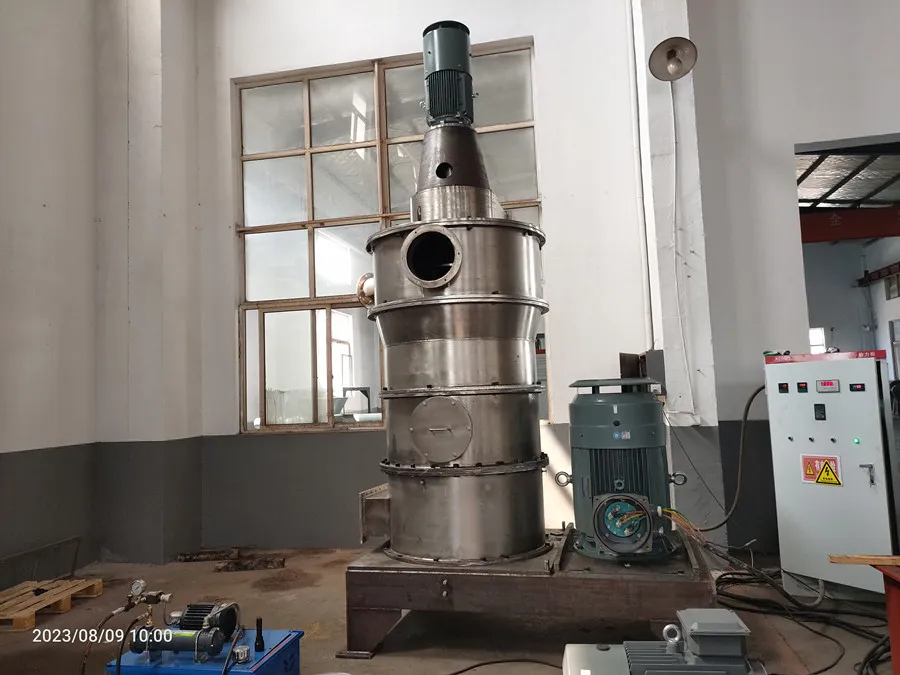
Overview of air classifier mill for rice husk grinding
Project Data
Material: Rice Husk
Moisture Content: <5%
Requirement: D50: 300 mesh
Production Capacity: 200-250 kg/h
Malaysia’s rice husk is a key by-product from rice processing. It has a steady annual output and is rich in cellulose and lignin.
Traditional recycling strategies involve:
- Power generation by burning waste
- Improving soil quality
- Creating low-value fuels
However, these methods often lack efficiency and can harm the environment.
To boost the value of rice husk, we need to turn it into high-quality finepowder material. This material is used in feed additives, activated carbon precursors, adsorbents, and premium composite substrates. Particle size, specific surface area, and shape of rice husk powder affect its use and processing costs. The main goal of the project is to set up a grinding line that is efficient, stable, and low-emission. This will help achieve a uniform distribution around 300 mesh, which is about 0.05 mm.
Grinding rice husk with air classifier mill
This project uses an air classifier mill (ACM) system. It combines grinding and classifying for rice husk.
Here’s a simplified version:
The process works like this: First, the rice husk is treated and dried. Then, it goes into a high-speed grinding zone. Here, mechanical shear and impact break it into primary powder. Next, it moves to a classification zone with a fine classifier. In this area, a vortex flow separates the coarser particles from the tiny micron-sized powder.
The classification wheel adjusts to different particle sizes. Coarse powder goes back into the grinding zone for more processing. This continues until the target particle size is reached. The ACM system controls airflow speed, grinding disc speed, classifier wheel speed, and baghouse separation pressure. This allows for precise control of particle size distribution. You can adjust the range from 80 to 1200 mesh, with a stable final product size around 300 mesh.
In operation, the system meets target particle size and production efficiency by focusing on these key points:
Pretreatment and Drying: Keep rice husk moisture under 10%. This helps reduce wear, cuts energy use, and boosts grinding efficiency.
Optimize grinding parameters by setting initial disc speeds between 20,000 and 30,000 rpm. Adjust air volumes to crush quickly and prevent overheating.
Classification Strategy:
Use high-precision classifier wheels.
Adjust air ducts to keep the coarse fraction regrind rate under 5%.
Maintain the particle size distribution peak at about 300 mesh.
Temperature Control and Wear Protection: The system has active cooling. It also uses wear-resistant coatings on key parts. This helps reduce wear and extend equipment life.
Energy consumption and emission control: A closed-loop airflow system and an efficient dust removal unit work together. They minimize dust emissions and reduce energy losses.
In this Malaysia project, rice husk powder reaches a 300-mesh size. It does this with high yield and low dust. The particle size is uniform and shows minimal fluctuation. The product acts as a high-performance additive and material precursor. It boosts both eco-friendliness and cost-effectiveness in later manufacturing processes.
 English
  Spanish
  German
  French