
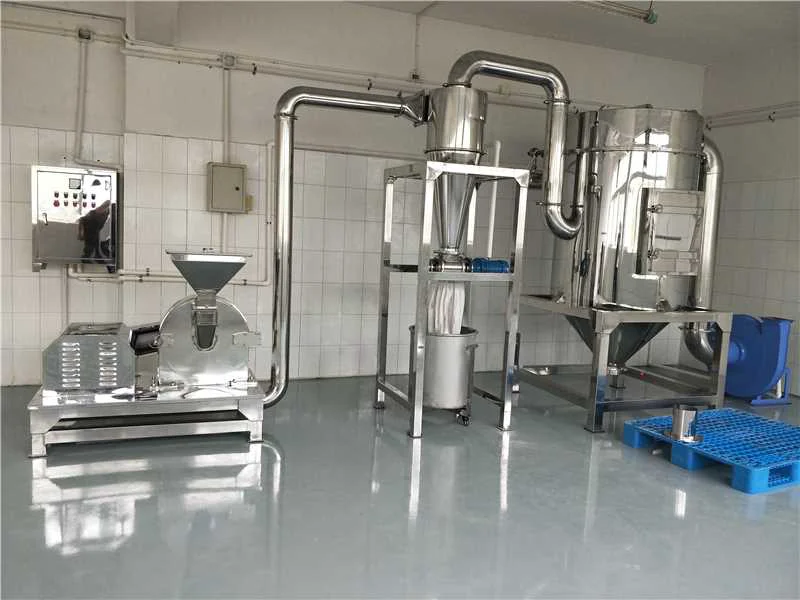
In the past, rice husks were handled in a crude manner, mostly being burned or randomly piled. Burning rice husks emits harmful gases. These include sulfur dioxide, nitrogen oxides, and particulate matter. These pollutants worsen air quality and create smog. They also threaten human health, causing respiratory problems and more. Randomly piled rice husks also occupy significant land resources. As time passes, the husks slowly decay. This creates leachate, which pollutes the soil and groundwater. It disrupts the ecological balance. The Thai government has jumped on this chance. They are promoting the use of rice husks. This aims to benefit both the environment and the economy. Against this backdrop, Thailand introduced the 80-mesh rice husk impact mill production line. This brought a new solution for processing rice husks and using resources effectively.
Rice Husk Impact Mill Production Line Parameters
- Material: Rice Husk
- Moisture Content: <5%
- Requirement: 80 mesh
- Production Capacity: 300-450 kg/h
Rice Husk Impact Mill Production Line Preliminary Test Video
EPIC Powder conducts pilot testing before every project. We talked with the client to understand their needs. Then, we ran tests on the rice husk impact mill. We will only continue with cooperation after confirming our equipment meets customer needs.
Benefits of the Production Line
The 80-mesh rice husk impact mill production line is now running in Thailand. This brings great benefits.
The production line has greatly cut down pollution. It addresses the harmful stacking and burning of rice husks. Rice husks used to pile up, taking up space. They decayed and created leachate, which polluted the soil and groundwater. Burning rice husks also released harmful gases, harming air and human health. Today, the production line changes rice husks into a useful resource. This process helps reduce environmental problems.
Economically, the production line has created a new economic growth point. Processed rice husk powder has a wide range of uses. It can be used as a feed additive to provide animal nutrients such as fiber. In the feed sector, rice husk applications accounted for approximately 38% of the total in 2024. It can also be used to manufacture building materials. A composite made from rice husk powder and polypropylene can be used for building formwork. This choice cuts costs, speeds up construction, and meets load-bearing needs. Statistics show that the use of building formwork can reduce project costs by over 31%. These applications have brought significant economic benefits to businesses.
The production line supplies top-notch raw materials for Thailand’s biomass energy sector. Rice husk powder can be burned to generate power and produce biofuel. This helps reduce Thailand’s reliance on fossil fuels. The rice husk power station in Pichit Province, Thailand, generates electricity using rice husks. Part of the electricity produced is used by the power station itself, and part is sold to the National Electricity Authority. This saves fuel oil and promotes energy diversity. It helps Thailand reach its sustainable energy goals.
 English
  Spanish
  German
  French