
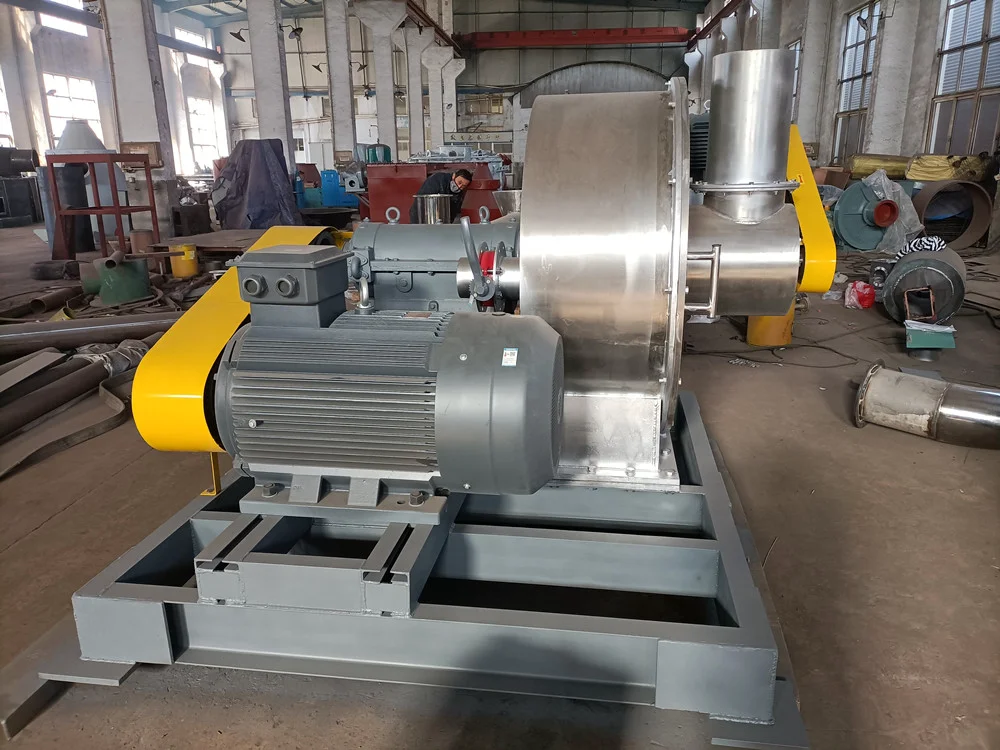
Project Data
- Material: Matcha
- Particle Size: D50 9.54 μm, D90 21.6 μm, D97 31 μm, D100 82 μm
- Output: 40 kg/h
- Machine Model: MJW-500L Classifying Mill
Taiwan’s premium tea culture drives demand for ultra-fine matcha powders with tight particle-size distributions. Achieving a D50 near 10 μm while preserving aroma, color, and nutritional profile requires careful control of grinding, drying, and classifying steps. The project explores a compact MJW-500L Classifying Mill configuration to produce a 10-micron-grade matcha at a steady 40 kg/h, suitable for ceremonial and high-end culinary applications.
Taiwan 10-Micron Matcha Classifying Mill Grinding Project System concept
The MJW-500L combines impact grinding with dynamic air-classification in a single integrated system. The workflow starts with pre-dried matcha going into the milling chamber. There, high-speed impacts create micro-particles. The ground material goes through a precision classifier. This device uses adjustable rotor speed and airflow to separate fines, targeting those smaller than 10 μm, from coarser fractions. The coarse stream is returned for regrinding, while the fine stream is collected. The system adjusts the milling rotor speed, classifier rotor speed, feeder rate, and airflow. This helps achieve a narrow particle-size distribution. It centers around the set D50 and D90 targets.
Preliminary Test of a 10-Micron Matcha Classifying Mill Project in Taiwan
Key performance drivers
Drying and conditioning: moisture kept below 5% to prevent clumping and ensure stable grinding.
Grinding dynamics: optimized rotor speed around the MJW-500L’s design range to maximize fracture without thermal damage.
Classification strategy: adjustable classifier speed and air flow to fix D50 at 9.54 μm and shape the tails for D90, D97, and D100.
Temperature control: integrated cooling paths to minimize heat buildup that could affect aroma and color.
Cleaning and hygiene: closed transfer piping and easy-clean components to protect the tea’s sensory attributes.
Targeted data table
| Parameter | Target | Notes |
|---|---|---|
| D50 | 9.54 μm | Core size for peak quality matcha |
| D90 | 21.6 μm | Ensures most particles remain ultra-fine |
| D97 | 31 μm | Upper tail control for consistency |
| D100 | 82 μm | Guard against excessive fines |
| Output | 40 kg/h | Consistent throughput with stable quality |
| Model | MJW-500L | Air classifying mill |
Operational considerations
Sensory impact: ultra-fine grinding can alter aroma; handle powders in low-oxidation environments and minimize heat exposure.
Color retention: short residence time in the mill helps preserve vivid green color.
Food-grade materials: all contact surfaces are stainless steel with hygienic design to meet tea industry standards.
Dust control: dust extraction and HEPA filtration minimize particulate exposure and product loss.
The Taiwan 10-Micron Matcha Classifying Mill project demonstrates that the MJW-500L can deliver a controlled 10 μm target with a 40 kg/h throughput while maintaining essential matcha qualities. The combination of precise milling and adaptive classification enables consistent particle-size distribution essential for premium matcha markets.
Would you like a comparison table with alternative mills or a brief process flow diagram to accompany this case?
 English
  Spanish
  German
  French